










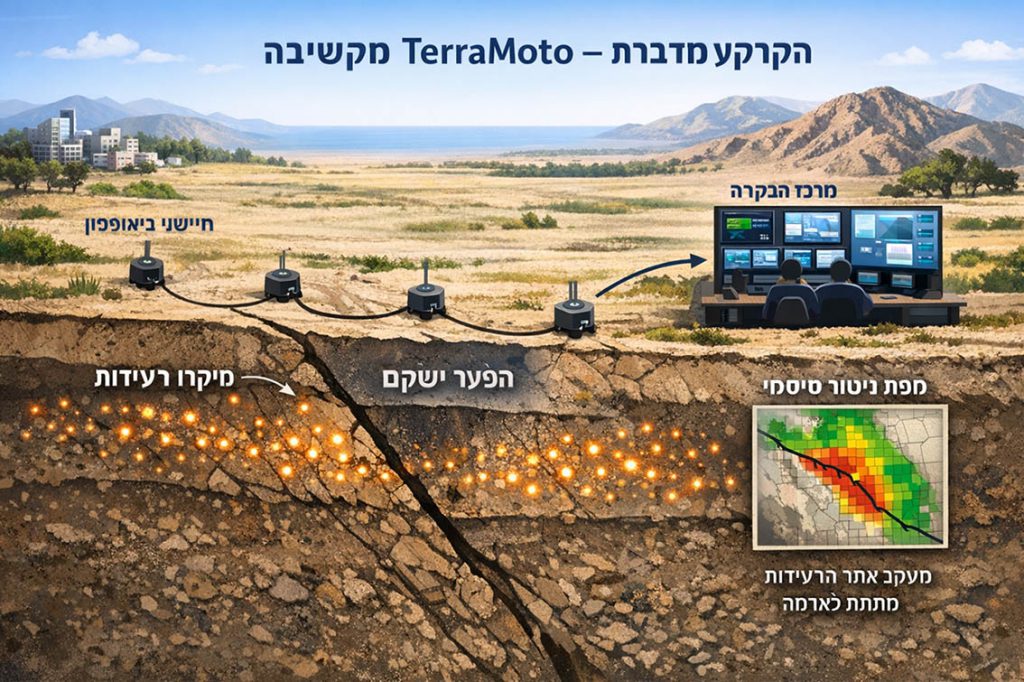

טכנולוגיה לחיזוי ומניעה של רעידות אדמה
מאמר זה מחולק ל 4 סעיפים: הסבר קליל והסבר מקצועי, עברית ואנגלית
מאת: מני נחמן
המבוא: להפסיק להיות מופתעים
רעידות אדמה הן אחד מאיתני הטבע המפחידים ביותר, בעיקר בגלל גורם ההפתעה. רובנו תופסים רעידת אדמה כאירוע שקורה "פתאום", אך האמת הגאולוגית שונה: הרעידה היא רק הסוף הרועש של תהליך שקט וממושך.
הפטנט של TerraMoto (באיטלקית: "רעידת אדמה") נולד מתוך ההבנה שאסור לנו להמשיך לחכות לאסון. במקום "לגלות" רעידת אדמה רק כשהיא מתרחשת, פיתחנו שיטה להקשיב לקרקע, לזהות את הסכנה בזמן אמת, ואפילו – במקרי קיצון – למנוע אותה.
הבעיה: הלחץ המצטבר
רעידות אדמה נוצרות לאורך "קווי שבר", היכן שגושי קרקע עצומים (לוחות טקטוניים) נעים זה מול זה.
ברוב הזמן, התנועה הזו איטית מאוד ולא מורגשת. הבעיה מתחילה כשהתנועה נתקעת. תחשבו על שני משטחי אבן מחוספסים שמנסים להחליק זה על זה אבל נתפסים בזיז בולט ("מעצור"). הלוחות ממשיכים ללחוץ, אבל המעצור מחזיק אותם במקום. הלחץ הולך ומצטבר, עד שהסלע נשבר בבת אחת. הרגע הזה הוא רעידת האדמה.
הפתרון: הקשבה לקרקע ("Listening to the Ground")
החידוש של TerraMoto הוא המעבר מגישה פסיבית לניטור אקטיבי ורציף.
לאורך קווי השבר מתרחשים כל הזמן "אירועים זעירים" – רעידות מיקרוסקופיות שאינן מורגשות לבני אדם ולא גורמות נזק. אירועים אלו הם למעשה שחרורי לחץ קטנים ובריאים, המעידים שהקרקע "זזה" בחופשיות.
איך זה עובד?
-
פריסת חיישנים: אנו פורסים רשת של גאופונים (חיישני קרקע רגישים) לאורך אזורים מועדים לפורענות.
-
יצירת "קו בסיס": המערכת לומדת את דפוס הרעשים הטבעי של האזור במשך תקופה (שנה-שנתיים) וממפה את ה"דופק" הרגיל של השבר.
-
זיהוי החריגה: המערכת מחפשת שינויים בדפוס. באופן אירוני, הסימן המדאיג ביותר הוא דווקא שקט.
הפרדוקס של "הפער השקט"
כאשר אנו מזהים מקטע לאורך קו השבר שבו פתאום אין רעידות קטנות, זהו "פער שקט". על פניו זה נשמע חיובי, אך גאולוגית זהו תמרור אזהרה: השקט הזה מעיד ככל הנראה על סלע חזק וגדול ש"נעל" את קו השבר. הלחץ שם לא משתחרר אלא מצטבר, כמו קפיץ שנדרך עוד ועוד.
זהו המפתח לחיזוי המדויק, המאפשר לנו לענות על שלוש שאלות קריטיות:
1. איפה? (המיקום)
מיקום ה"פער השקט" מסמן לנו בדיוק היכן נמצא המוקד המסוכן ("המעצור") שבו עלולה להתרחש הרעידה הגדולה הבאה.
2. כמה חזק? (העוצמה)
ברגע שזיהינו את המיקום, אנו מבצעים אפיון הנדסי של גודל המעצור וחוזק הסלע (לעיתים באמצעות דגימות שטח). שילוב הנתונים מאפשר לנו לחשב את כמות האנרגיה האגורה שם ולהעריך את עוצמת הרעידה הצפויה (מגניטודה).
3. מתי? (חלון הזמן)
באמצעות מדידות GPS מדויקות, אנו מודדים את מהירות התנועה של הלוחות משני צדי השבר. זהו "קצב הטעינה" של הלחץ. כשאנו יודעים מה סף השבירה של הסלע ובאיזה קצב הלחץ עולה, אנו יכולים לספק חלון זמן הסתברותי להתרחשות הכשל. זה לא תאריך ושעה ביומן, אלא טווח זמן שמאפשר להיערך ברצינות.
השלב הבא: ממודעות למניעה
הכוח האמיתי של TerraMoto הוא ביכולת לקבל החלטות מושכלות:
-
היערכות חכמה: במקום לחזק את כל המדינה, ניתן למקד משאבים בחיזוק מבנים ותשתיות באזור הספציפי שאותר, ולרענן נהלי חירום במערכות גז, חשמל ותחבורה.
- מניעה אקטיבית (Stress Management):זהו החלק המהפכני ביותר בשיטה. בתרחישי קיצון, בהם מזוהה סכנה לרעידת אדמה קטסטרופלית שעלולה להחריב ערים, השיטה מציעה פתרון הנדסי נועז: שחרור לחץ יזום.באמצעות סדרת קידוחים מבוקרים אל תוך "סלע המעצור", ניתן לשחרר את הלחץ באופן הדרגתי או ליצור סדקים שיאפשרו תנועה חלקה. הפעולה הופכת את ה"מכה" האדירה לסדרת תנועות קטנות ולא מזיקות, ובכך למעשה מונעת את האסון הגדול.
סיכום
TerraMoto מאפשרת לאנושות לעבור מגישה של "נחכה ונקווה לטוב", לגישה מודרנית של איתור, הערכה וניהול סיכונים. הטכנולוגיה הופכת את האדמה המסתורית למערכת מדידה, ומעניקה למקבל ההחלטות את הדבר היקר ביותר: זמן להיערך ויכולת למנוע את האסון הבא.

זיהוי אופרטיבי של מקטעים נעולים ומתווה למיטיגציה פעילה של סיכונים סייסמיים
הסבר מקצועי:
מסמך זה מציג מסגרת אינטגרטיבית (TerraMoto) לניטור, הערכה וניהול סיכונים לאורך העתקים פעילים. בניגוד לגישות סטטיסטיות קלאסיות, השיטה המוצעת מתמקדת בפיזיקה של הכשל: איתור מרחבי-זמני של מקטעים נעולים (Locked Asperities) באמצעות ניתוח אנומליות במיקרו-סייסמיות, בשילוב עם נתוני גאודזיה (GNSS) להערכת קצב צבירת המאמץ (Strain Accumulation). המאמר מתווה דרך להמרת נתונים אלו לחלון זמן הסתברותי להתרחשות כשל, ומציע – בתרחישי קיצון – מנגנון תאורטי למניעה אקטיבית באמצעות שחרור מאמצים מבוקר (Stress Release Management).
1. מבוא: מעבר מחיזוי דטרמיניסטי להערכת מצב פיזיקלית
הקהילה הסייסמולוגית נמנעת לרוב מהמונח "חיזוי" (Prediction) בשל האופי הכאוטי של מערכות שבר. עם זאת, התקדמות ביכולות הניטור מאפשרת כיום מעבר ל"חיזוי תלוי-זמן" (Time-Dependent Forecasting). הנחת היסוד של TerraMoto היא שרעידות אדמה חזקות אינן אירועים אקראיים לחלוטין, אלא תוצאה סופית של תהליך מכני מדיד: הצטברות חיכוך על פני "אספריטי" (Asperity) – מקטע סלע בעל התנגדות גזירה גבוהה המונע החלקה רציפה. זיהוי מוקדם של מקטעים אלו הוא המפתח להערכת הסיכון.
2. מתודולוגיה: זיהוי ה"פער השקט" (Seismic Gap Definition)
האתגר המרכזי הוא להבחין בין אזור שקט סייסמית שאינו פעיל, לבין אזור "נעול" צובר מאמץ. השיטה מבוססת על אינטגרציה של שלושה וקטורים:
2.1 ניטור מיקרו-סייסמי (Microseismicity)
פריסת מערך גאופונים צפוף מאפשרת זיהוי אירועים בסף מגניטודה נמוך ($M < 1.0$).
המדד הקריטי אינו רק כמות הרעידות, אלא אחידות סף הגילוי ($M_c$ – Magnitude of Completeness).
-
ההשערה: לאורך העתק פעיל (Creeping Fault), מתקיימת פעילות מיקרו-סייסמית רקעית כתוצאה משחרור מאמצים לוקלי.
-
האנומליה: מקטע המציג ירידה מובהקת בקצב האירועים ("פער שקט") ביחס לסביבתו ולציר הזמן, חשוד כמקטע נעול ($Locked Patch$). באזור זה, המאמץ הטקטוני נצבר אלסטית בסלע במקום להשתחרר כחום או כתזוזה.
2.2 צימוד גאודטי (Geodetic Coupling)
כדי לאמת שה"שקט" אכן נובע מנעילה, נדרשת הצלבה עם מדידות GNSS רציפות. חישוב שדה המהירות היחסית ($v$) בין שני צדי השבר מאפשר לחשב את הגירעון בהחלקה (Slip Deficit – $\dot{D}$):
כאשר $v_{creep} \to 0$, ניתן להסיק שהמקטע נעול לחלוטין וקצב צבירת המאמץ מקסימלי.
2.3 אפיון האספריטי (Asperity Characterization)
לאחר איתור המיקום ($Location$), יש להעריך את פוטנציאל הנזק. זהו שילוב של:
-
שטח המקטע הנעול ($A$): נגזר ממיפוי הגבולות של הפער הסייסמי.
-
חוזק הסלע: דגימה גאולוגית (Core sampling) או סקרים גיאופיזיים להערכת מודול הגזירה ($\mu$) וסף הכשל.
3. מודל להערכת מגניטודה וזמן
על בסיס הנתונים הנ"ל, המערכת מייצרת אומדן כמותי:
א. הערכת מומנט סייסמי מקסימלי ($M_0$):
על פי הקשר הפיזיקלי:
כאשר $D_{potential}$ הוא ההחלקה המצטברת שנמנעה עד כה. מכאן נגזרת המגניטודה הצפויה ($M_w$).
ב. חלון זמן הסתברותי:
בניגוד לניבוי נקודתי, המודל מציע חלון זמן המבוסס על קצב הטעינה. אם ידוע סף הכשל המשוער ($\tau_{max}$) והמאמץ הנוכחי ($\tau(t)$), הזמן לכשל ($T_{failure}$) מוערך לפי:
התוצאה היא פונקציית צפיפות הסתברות (PDF) המצביעה על העלייה בסיכון בטווח הזמן הקרוב.
4. אסטרטגיית מיטיגציה: מניעה אקטיבית (Stress Management)
החדשנות הרדיקלית בגישת TerraMoto טמונה במעבר מניטור פסיבי להתערבות אקטיבית.
במקרים בהם המודל מזהה אספריטי בעל פוטנציאל אנרגטי קטסטרופלי ($M_w > 7.0$ באזור אורבני), מוצע לשקול התערבות הנדסית: Induced Aseismic Slip.
-
העיקרון: הפחתת החיכוך היעיל ($\mu_{eff}$) במקטע הנעול.
-
היישום: ביצוע קידוחים עמוקים (Deep Boreholes) אל מישור השבר והזרקת נוזלים בלחץ מבוקר (או שימוש במטענים זעירים ממוקדים) שמטרתם:
-
לשנות את לחץ הנקבוביות (Pore Pressure).
-
לאלץ את המערכת לשחרר אנרגיה בסדרת אירועים קטנים ומבוקרים ($Micro-earthquake swarms$).
-
למנוע את ההצטברות עד לכדי כשל קטסטרופלי יחיד.
-
5. דיון וסיכום
גישת TerraMoto מציעה פרדיגמה חדשה בניהול סיכוני רעידות אדמה. היא מחליפה את הגישה הסטטיסטית ("רעידה כל X שנים בממוצע") בגישה דטרמיניסטית-פיזיקלית המבוססת על ניטור מצב המאמץ בזמן אמת.
בעוד ששלב הניטור וההתרעה (EWS) ישים באופן מיידי בטכנולוגיות קיימות, שלב המניעה האקטיבית דורש מחקר נוסף, רגולציה קפדנית ושיתוף פעולה בינלאומי. עם זאת, הפוטנציאל להצלת חיים ולמניעת נזק כלכלי בממדי ענק הופך את הפיתוח לכזה בעל חשיבות אסטרטגית עליונה.
נספח טכני: פרמטרים לבדיקת היתכנות
-
Mc Stability: הבטחת יציבות סף גילוי למניעת False Positives.
-
Deconvolution: סינון רעשים אנתרופוגניים מהמידע הסייסמי.
-
Locking Inversion: שימוש באלגוריתמים הפוכים לגזירת עומק הנעילה מנתוני שטח.

Article 1: The Public & General Version
(Suitable for media, investors, and general audience)
From Unpredictable Disaster to Managed Risk
By: Meny Nachman
Introduction: Ending the Element of Surprise
Earthquakes are among the most terrifying forces of nature, primarily due to their unpredictability. Most of us perceive an earthquake as a sudden event that strikes out of nowhere. However, the geological truth is different: the quake itself is merely the violent finale of a long, silent process.
TerraMoto (Italian for "Earthquake") was born from the realization that we can no longer afford to simply wait for disaster. Instead of detecting earthquakes only after they happen, we have developed a method to listen to the ground, identify danger in real-time, and—in extreme cases—prevent it.
The Problem: The Silent Accumulation
Earthquakes originate along "fault lines," where massive tectonic plates slide past one another. Most of the time, this movement is slow, constant, and harmless. The danger arises when this movement gets stuck.
Imagine two rough stone surfaces trying to slide but getting caught on a protruding "brake" or "stopper." The tectonic plates continue to push, but the locked patch holds them in place. Pressure builds up silently over years, like a compressed spring, until the rock eventually snaps. That moment of fracture is the earthquake.
The Solution: Listening to the Ground
TerraMoto shifts the paradigm from passive waiting to active, continuous monitoring.
Along fault lines, "micro-events" occur constantly—tiny, imperceptible tremors that cause no damage. These are actually healthy signs, indicating that the ground is moving freely and releasing small amounts of stress.
How it Works:
-
Sensor Deployment: We deploy a dense network of geophones (sensitive ground sensors) along high-risk zones.
-
Establishing a Baseline: The system learns the area's natural acoustic pattern over a period (1-2 years), mapping the fault's normal "heartbeat."
-
Identifying Anomalies: The system looks for breaks in the pattern. Ironically, the most alarming signal is silence.
The Paradox of the "Seismic Gap"
When we identify a segment along the fault where micro-tremors suddenly cease, we call this a "Seismic Gap." While silence sounds peaceful, geologically it is a warning sign: it indicates a massive, strong rock formation has "locked" the fault. Pressure is not being released; it is accumulating.
This insight allows us to answer the three most critical questions:
1. Where? (Location)
The location of the "Seismic Gap" pinpoints exactly where the dangerous "brake" is located—the epicenter of the next potential major rupture.
2. How Big? (Magnitude)
Once the location is identified, we characterize the size of the locked patch and the rock strength (sometimes via physical sampling). Combining this data allows us to calculate the stored energy and estimate the potential magnitude of the event.
3. When? (The Time Window)
Using precise GNSS (GPS) measurements, we measure the velocity of the tectonic plates on either side of the fault. This is the "charging rate" of the pressure. Knowing the rock's breaking point and the rate of pressure buildup allows us to provide a probabilistic time window for the failure. It is not an exact calendar date, but a specific timeframe that enables serious preparedness.
The Next Step: From Awareness to Prevention
The true power of TerraMoto lies in enabling actionable decisions:
-
Smart Preparedness: Instead of reinforcing an entire country, resources can be focused on strengthening infrastructure in the specific identified zone, alongside updating emergency protocols for gas, power, and transport systems.
- Active Prevention (Stress Management):This is the most revolutionary aspect of the method. In extreme scenarios, where a catastrophic earthquake threatens to destroy cities, the method proposes a bold engineering solution: Controlled Stress Release.Through a series of deep, controlled drillings into the "locking rock," we can gradually release the pressure or induce micro-cracks to allow smooth movement. This action converts a potential mega-disaster into a series of small, harmless motions—effectively preventing the catastrophe.
Conclusion
TerraMoto allows humanity to transition from a "wait and hope" approach to a modern strategy of detection, evaluation, and risk management. The technology transforms the mysterious earth into a measurable system, granting decision-makers the most valuable asset of all: the time to prepare and the power to prevent.
Article 2: The Academic & Technical Version
(Suitable for seismologists, engineers, and government policy-makers)
Operational Identification of Locked Asperities and a Framework for Active Seismic Mitigation: The TerraMoto Approach
Abstract
This paper presents an integrative framework (TerraMoto) for monitoring, assessing, and managing risks along active faults. Contrary to classical statistical approaches, the proposed method focuses on the physics of failure: spatiotemporal detection of Locked Asperities via microseismicity anomaly analysis, combined with geodetic (GNSS) data to estimate Strain Accumulation rates. The paper outlines a pathway for converting these data points into a probabilistic time window for failure and proposes—in extreme scenarios—a theoretical mechanism for active prevention via Controlled Stress Release Management.
1. Introduction: From Deterministic Prediction to Physical Assessment
The seismological community generally avoids the term "prediction" due to the chaotic nature of fault systems. However, advancements in monitoring capabilities now allow a shift toward "Time-Dependent Forecasting." The underlying premise of TerraMoto is that strong earthquakes are not random events, but the deterministic result of a measurable mechanical process: friction accumulation on an Asperity—a rock segment with high shear resistance that prevents continuous creep. Early identification of these segments is key to risk assessment.
2. Methodology: Defining the "Seismic Gap"
The central challenge is distinguishing between a seismic zone that is inactive and one that is "locked" and accumulating stress. The method relies on the integration of three vectors:
2.1 Microseismic Monitoring
Deploying a dense array of geophones allows for the detection of events at a low magnitude threshold ($M < 1.0$).
The critical metric is not merely the event count, but the stability of the Magnitude of Completeness ($M_c$).
-
Hypothesis: Along an active creeping fault, background microseismicity exists due to local stress release.
-
The Anomaly: A segment exhibiting a statistically significant drop in event rate (a "Seismic Gap") relative to its surroundings and historical baseline is suspected as a Locked Patch. In this zone, tectonic stress is accumulating elastically rather than being released as heat or displacement.
2.2 Geodetic Coupling
To verify that the "silence" is due to locking, cross-referencing with continuous GNSS data is required. Calculating the relative velocity field ($v$) between the two sides of the fault allows for the derivation of the Slip Deficit ($\dot{D}$):
When $v_{creep} \to 0$, it can be inferred that the segment is fully locked and the strain accumulation rate is maximal.
2.3 Asperity Characterization
Following localization, the potential damage must be estimated. This involves:
-
Area of Locked Patch ($A$): Derived from mapping the boundaries of the seismic gap.
-
Rock Strength: Core sampling or geophysical surveys to estimate the Shear Modulus ($\mu$) and failure threshold.
3. Magnitude and Time Estimation Model
Based on the above data, the system generates a quantitative estimate:
A. Maximum Seismic Moment ($M_0$):
Based on the physical relationship:
Where $D_{potential}$ is the accumulated slip deficit. From this, the expected Moment Magnitude ($M_w$) is derived.
B. Probabilistic Time Window:
Unlike point-prediction, the model offers a window based on loading rates. If the estimated failure threshold is $\tau_{max}$ and the current stress is $\tau(t)$, the time to failure ($T_{failure}$) is approximated by:
The result is a Probability Density Function (PDF) indicating the increasing risk over the near-term timeline.
4. Mitigation Strategy: Active Stress Management
The radical innovation of the TerraMoto approach lies in the transition from passive monitoring to active intervention.
In cases where the model identifies an asperity with catastrophic energy potential ($M_w > 7.0$ in urban areas), engineering intervention is proposed: Induced Aseismic Slip.
-
Principle: Reducing the effective friction ($\mu_{eff}$) within the locked segment.
-
Application: Deep borehole drilling into the fault plane and controlled fluid injection (or targeted low-yield explosive fracturing) aimed at:
-
Modulating Pore Pressure.
-
Forcing the system to release energy via a series of controlled Micro-earthquake swarms.
-
Preventing accumulation toward a single catastrophic failure.
-
5. Discussion and Conclusion
TerraMoto proposes a new paradigm in earthquake risk management. It replaces the statistical approach ("an earthquake every X years on average") with a deterministic-physical approach based on real-time stress monitoring.
While the Early Warning System (EWS) phase is immediately applicable with current technologies, the Active Mitigation phase requires further research, strict regulation, and international cooperation. However, the potential to save lives and prevent massive economic loss renders this development a strategic priority of the highest order.
Technical Appendix: Feasibility Parameters
-
Mc Stability: Ensuring detection threshold stability to prevent False Positives.
-
Deconvolution: Filtering anthropogenic noise from seismic data.
-
Locking Inversion: Using inverse algorithms to derive locking depth from surface data.


